class: center, middle, inverse, title-slide .title[ # Network structures and collective behavior of AI agents ] .author[ ### David Garcia <br> <em>University of Konstanz <br> also at: Barcelona Supercomputing Center <br> Complexity Science Hub Vienna</em> ] .date[ ### slides at dgarcia.eu/LLM-consensus ] --- background-image: url(figures/AboutUS.svg) background-size: 98% --- layout: true <div class="my-footer"><span><a href="https://arxiv.org/abs/2409.02822"> AI agents can coordinate beyond human scale. G de Marzo, C. Castellano, D. Garcia. Arxiv preprint (2025)</a></span></div> --- # Outline # 1. Collective behavior of AI agents # 2. Short overview of AI agents projects --- ## Understanding Online Collective Behavior .pull-left[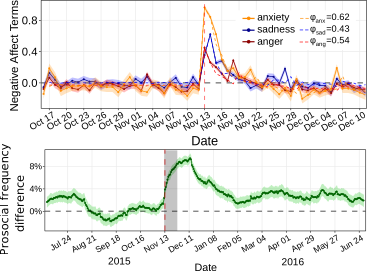 - Analysis of collective emotions - Focus on social media data - (Affective) polarization dynamics ] .pull-right[.center[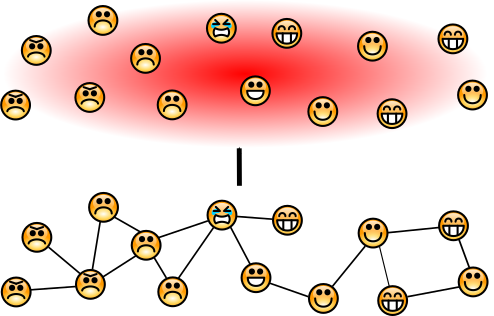] - **Agent-Based Modelling (ABM)** - Explaining macro-level phenomena forom micro-level dynamics - Now in combination with LLMs ] --- # AI agents: LLMs Within Society .center[] - AI "chiefs of staff" promise to interact with each other in our behalf - Coordination and competition (reservations, negotiations, applications) - **Could norms emerge, for example rules to be more efficient?** - **Could they have systemic risks, like flash crashes?** --- # The Social LLM Hypothesis .pull-left[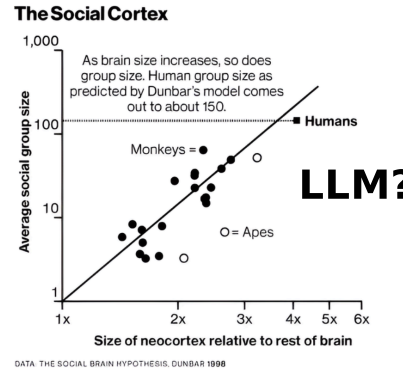] .pull-right[ - Group formation and sustainability: size depends on cognitive ability - Memory of identity to predict behavior and cooperation - Language as a tool for humans to make larger groups: - Dunbar's number (150-250) ** Our questions:** - Typical cohesive group size of AI agents? - Does it scale with with cognitive/language abilities? ] --- # Coordination and Critical Group Size .center[] Coordination: When the option does not matter, what matters is staying together --- # Coordination Dynamics in LLM Agents .pull-left[.center[]] .pull-right[ - Simulation of a tight group of N interacting agents - Agents start with a random opinion of two options - Each iteration, they see the opinions of all others (prompt) - They respond to the question of their opinion - Opinion labels need to be random and shuffled to avoid token biases - Consensus is achieved if all have the same opinion ] --- # Detailed Prompt for Simulation > Below you can see the list of all your friends together with the opinion they support. <br> You must reply with the opinion you want to support. The opinion must be reported between square brackets. <br> X7v A keY B 91c B gew A 4lO B ... Reply only with the opinion you want to support, between square brackets. --- # Coordination and Group Size .center[] - Simulating splitting by options (e.g. right/left) leads to stable groups - What is the maximum group size that allows AI agents to stay together? --- # LLM-Dependent Consensus Formation .center[] Some LLMs can reach consensus for completely arbitrary decisions (50 agents) --- # Understanding LLM Opinion Dynamics .center[] Agent opinion changes follow an S-function parametrized by a majority force `\(\beta\)` --- # Majority Force and Group Size .center[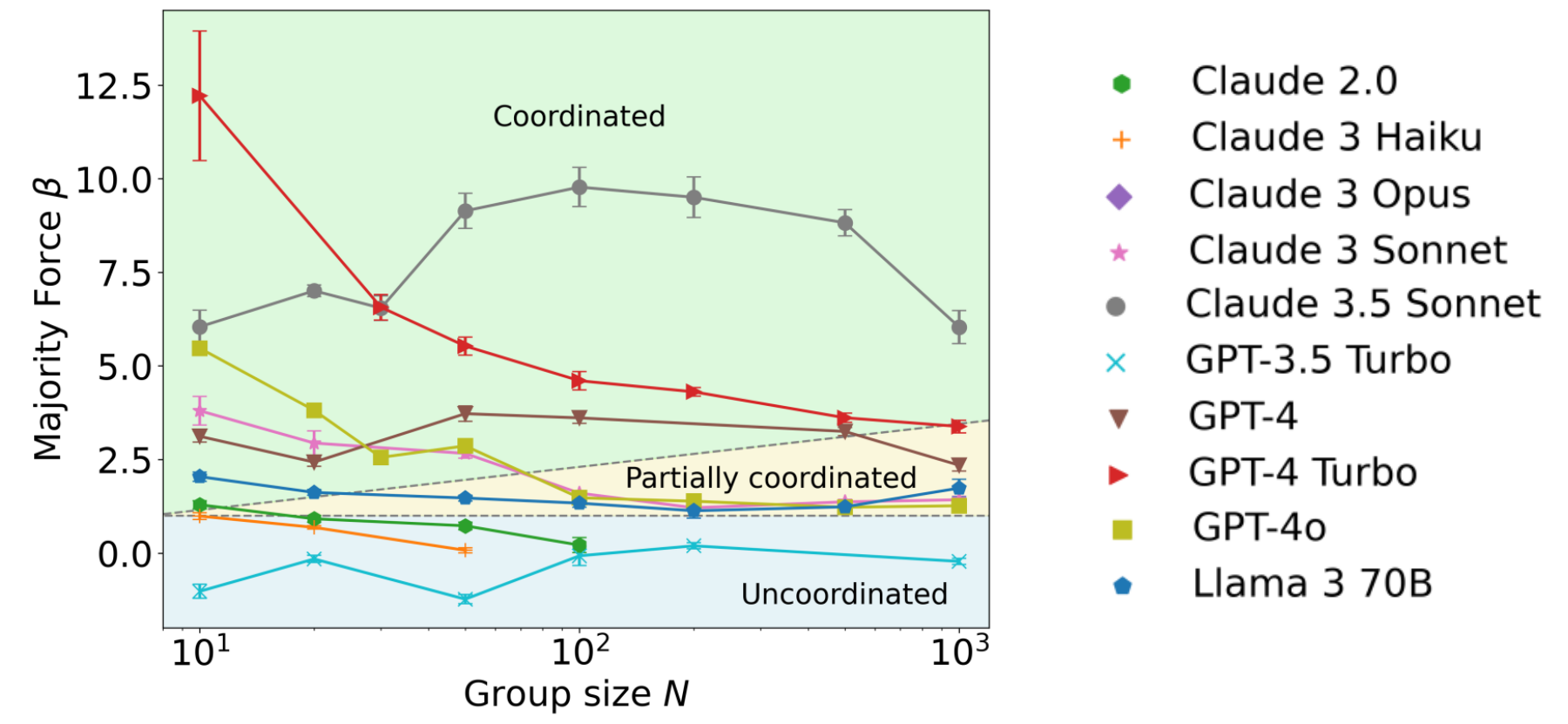] - Majority force decreases for larger group sizes: Three kinds of states --- ## Critical Group Size and Consensus Time `\(T_c\)` .pull-right[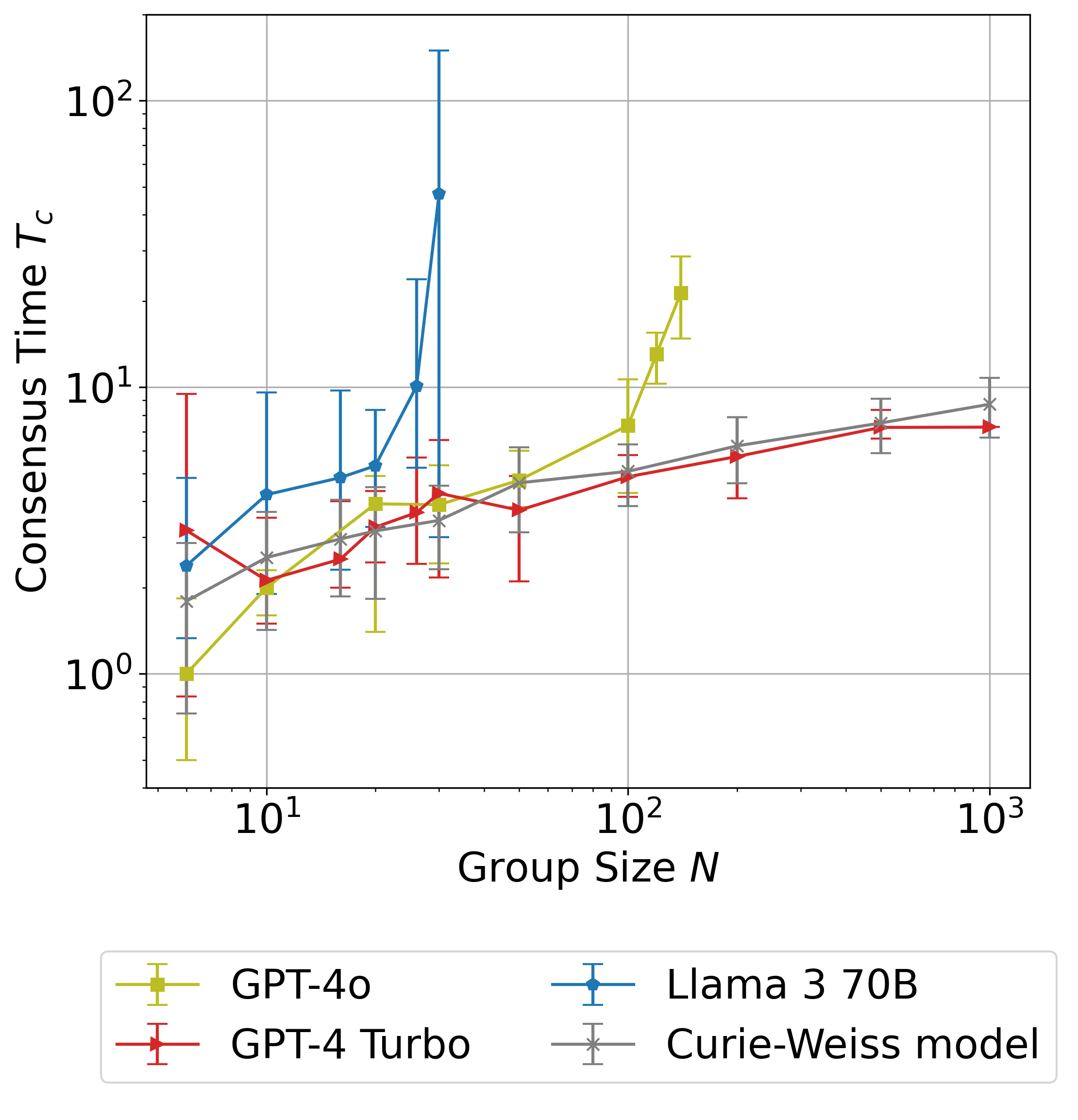] - Analysis of critical group size `\(N_c\)` - `\(N>N_c\)`: time to consensus `\(T_c\)` grows exponentially with `\(N\)` - Above critical size, consensus is unfeasible and happens only by chance - `\(T_c\)` can be calculated from `\(\beta\)` as in an Ising Model (i.e. time to magnetization as a function of inverse temperature) - `\(N_c\)` can be derived from `\(\beta\)` as the point of phase transition of `\(T_c\)` ( `\(\beta_c=1\)` ) --- ## Group Size and Language Understanding .pull-right[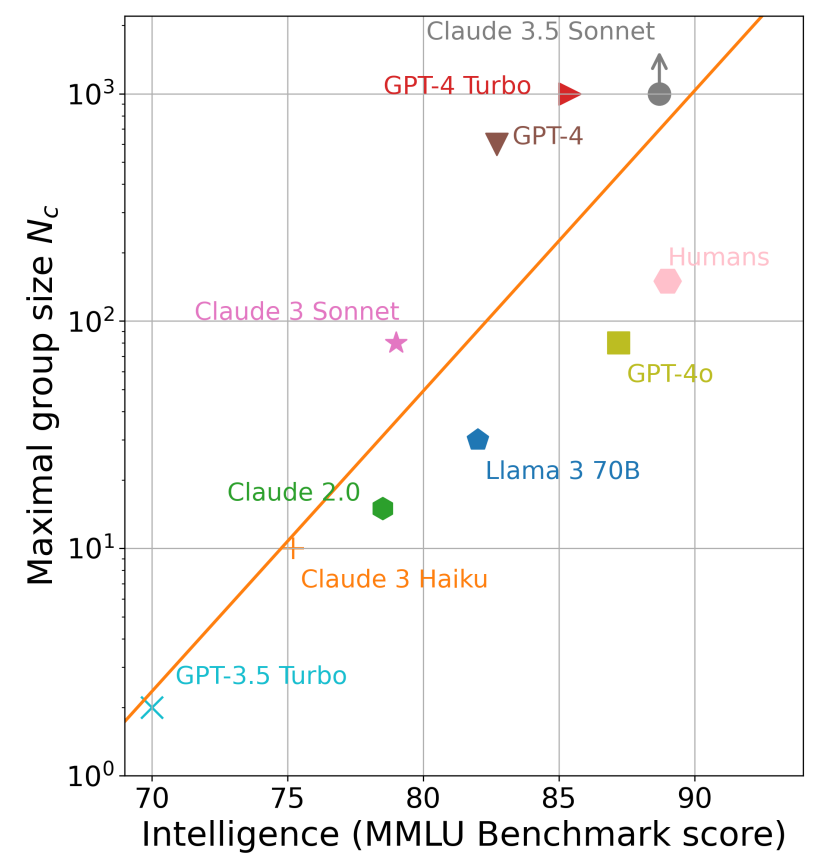] - Analysis of majority force and exhaustive simulations to measure **critical consensus size** - Exponential function of MMLU benchmark: **language understanding** - Two different scalings? - GPT-4 and Claude 3.5 Sonnet reach consensus for `\(N=1000\)` - LLM emergent consensus scale beyond humans --- # Short overview of AI agents projects # 1. Collective behavior of AI agents # *2. Short overview of AI agents projects* --- ## Collective misalignment Coordination paradigm with real issues. E.g.: open borders / closed borders, universal healthcare / private healthcare, tax the rich / lower taxes .center[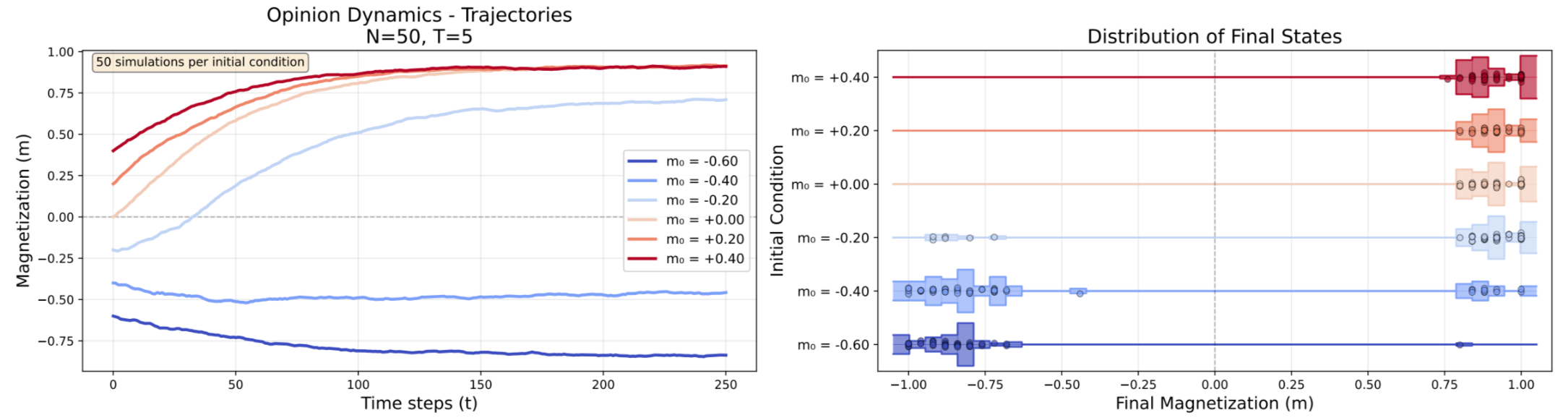] - Opinion 1: gender self-identification / Opinion 2: biological sex classification - The model prefers one option (gender self-identification) - But if the initial group is mostly for option 2, it can stay in that state --- ## Issue-dependent bias and majority force .center[] --- ## Testing the conformity paradigm with LLMs .center[] - People around choose the different line, wrong color, or box with different number of points - Social Impact Theory for humans: conformity increases with number of people wrong, their similarity, social strength, etc... --- ## Conformity across LLMs .center[] - Conformity is present and varies across LLMs - Similar level across tasks for the same model --- ## Social effects on conformity .center[] - AI agents conform more than humans (100% vs 30%) and are sensitive to identity of sources and social context --- ## Informational vs normative conformity .center[] - Some models have stronger conformity when their choices are public --- # The dangers of AI agents online .center[] <a href="https://arxiv.org/abs/2506.06299"> How Malicious AI Swarms Can Threaten Democracy: The Fusion of Agentic AI and LLMs Marks a New Frontier in Information Warfare. Schroeder el al (2025)</a> --- ## **WHAT-IF:** Social simulation with **Generative ABM** .center[] --- # The Collective Turing Test .center[] --- # LLMs can simulate online discussions .center[] Participants cannot distinguish conversations created with Llama 3 from human conversations --- # Summary - AI agents show conformity as humans - LLM consensus scale predicted by language understanding capabilities - LLMs can reach emergent consensus at scales beyond humans - **Opportunity: decision-making or coordination?** - **Risk: undesired synchronization like a flash crash?** - **Future: Social simulation with LLMs ** <a href="https://arxiv.org/abs/2409.02822"> AI agents can coordinate beyond human scale. G de Marzo, C. Castellano, D. Garcia. Arxiv (2025) </a> <a href="https://arxiv.org/abs/2511.08592"> The Collective Turing Test: Large Language Models Can Generate Realistic Multi-User Discussions. A. Bouleimen, G. De Marzo, T. Kim, N. Pagan, H. Metzler, S. Giordano, D. Garcia. Arxiv preprint (2025) </a> .center[**More at: [www.dgarcia.eu](https://dgarcia.eu)**, **[Bluesky: @dgarcia.eu](https://bsky.app/profile/dgarcia.bsky.social)**]